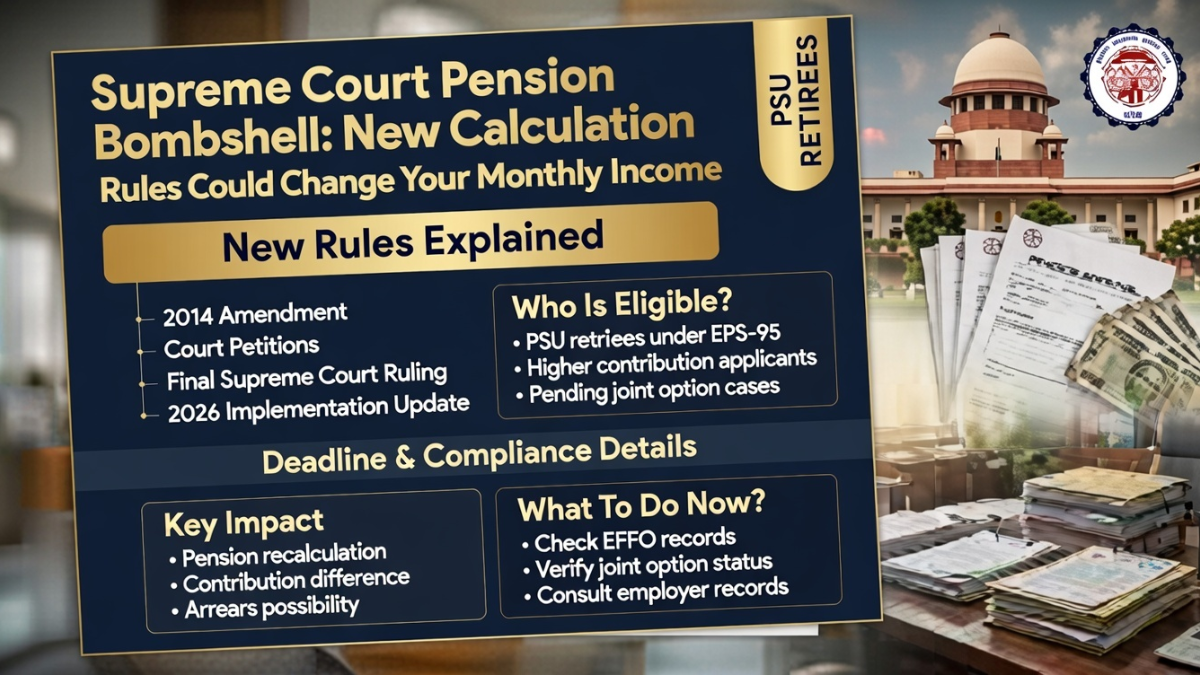
The latest Supreme Court pension rules update has sparked nationwide discussion among employees, retirees, and pensioners. With new clarifications on pension calculation methods and eligibility conditions, thousands are reviewing their retirement benefits to understand how the changes could affect their monthly income.
Whether you are a government employee, EPFO member, or nearing retirement, this update could influence how your pension is calculated and what benefits you ultimately receive. Here is a clear and detailed explanation of the revised guidelines and eligibility framework.
Why the Supreme Court Pension Update Matters
Pension disputes have been ongoing for years, especially concerning calculation formulas, wage ceilings, and higher pension options. Many retirees argued that pension benefits were being calculated on outdated wage caps rather than actual salary contributions.
The Supreme Court’s clarification has focused on ensuring fairness in pension computation while also maintaining financial sustainability of pension funds. These guidelines are particularly relevant for employees under contributory pension schemes such as EPS and certain government service rules.
The ruling has emphasized transparency in pension calculation and proper implementation of contribution-based benefits.
Revised Pension Calculation Guidelines Explained
One of the central points in the update relates to how pension is calculated.
Traditionally, pension amounts were calculated based on:
Average salary during the final years of service
Years of pensionable service
Wage ceiling limits defined under scheme rules
In several cases, employees who contributed on higher actual salaries argued that their pension should reflect those contributions instead of being restricted to statutory wage caps.
The Supreme Court clarified that pension benefits should align with contribution records, subject to scheme conditions. However, employees opting for higher pension must comply with contribution adjustments and applicable rules.
This means:
If higher contributions were made properly, pension may be calculated on actual salary.
If contributions were limited to wage ceiling limits, pension calculation remains capped accordingly.
Proper documentation and timely option exercise are critical.
Eligibility Criteria Under the Updated Framework
Eligibility rules remain structured but more clearly defined.
Employees must:
Have completed the minimum pensionable service period
Have made valid contributions under the applicable scheme
Exercise higher pension options within prescribed timelines where applicable
Meet documentation and verification requirements
For pensioners seeking revision, eligibility often depends on whether they opted for higher contribution plans during service.
Late applications or incomplete records may not qualify for revised calculation.
Impact on Existing Pensioners
The biggest question among retirees is whether existing pensions will increase.
For those who opted for higher pension based on actual salary contributions and meet scheme criteria, recalculation may result in higher monthly pension.
However, pensioners who contributed only up to the statutory wage ceiling may not see changes unless future policy reforms are introduced.
Arrears, if applicable, depend on implementation guidelines and administrative processing timelines.
Higher Pension Option and Compliance Requirements
The higher pension option remains a significant component of the debate.
Employees seeking pension on higher salary must:
Submit joint option forms with employer
Provide proof of higher contributions
Ensure contribution differentials are paid where required
Failure to comply with procedural requirements may affect eligibility.
The Supreme Court emphasized adherence to scheme provisions while protecting legitimate contributors.
Clarification on Pension Fund Sustainability
While retirees demand higher payouts, the court has also highlighted the importance of maintaining pension fund sustainability.
Increasing benefits without adequate contributions can strain long-term viability.
Therefore, contribution alignment with benefit calculation remains central to the updated approach.
What Employees Nearing Retirement Should Know
If you are close to retirement, it is essential to:
Review your contribution records carefully
Confirm whether higher contribution options were exercised
Check official circulars related to pension calculation
Maintain documentation of salary and contribution history
Early verification can prevent disputes after retirement.
Common Misunderstandings About the Update
Many social media posts suggest automatic pension increases for all retirees. This is not accurate.
Pension recalculation depends on eligibility, contribution history, and compliance with scheme guidelines.
No blanket increase applies universally without meeting specified conditions.
Administrative Implementation and Processing
Implementation depends on notifications issued by pension authorities and EPFO administrative updates.
Processing may take time due to verification of contribution records and option forms.
Pensioners are advised to rely only on official communications for clarity.
Conclusion
The Supreme Court pension rules update provides important clarity on pension calculation methods and eligibility criteria. While the decision supports fairness for employees who contributed based on higher salaries, it also reinforces compliance with scheme provisions and sustainability principles.
For retirees and employees nearing retirement, reviewing contribution records and understanding eligibility rules is critical. Staying informed through official notifications ensures accurate expectations and smoother benefit processing.
Disclaimer: This article is for informational purposes only and does not constitute legal advice. Pension eligibility and calculation depend on official scheme guidelines and administrative implementation. Always verify details with authorized pension authorities.